
Azmat Ullah Khan
May 25, 2025 at 02:27 PM
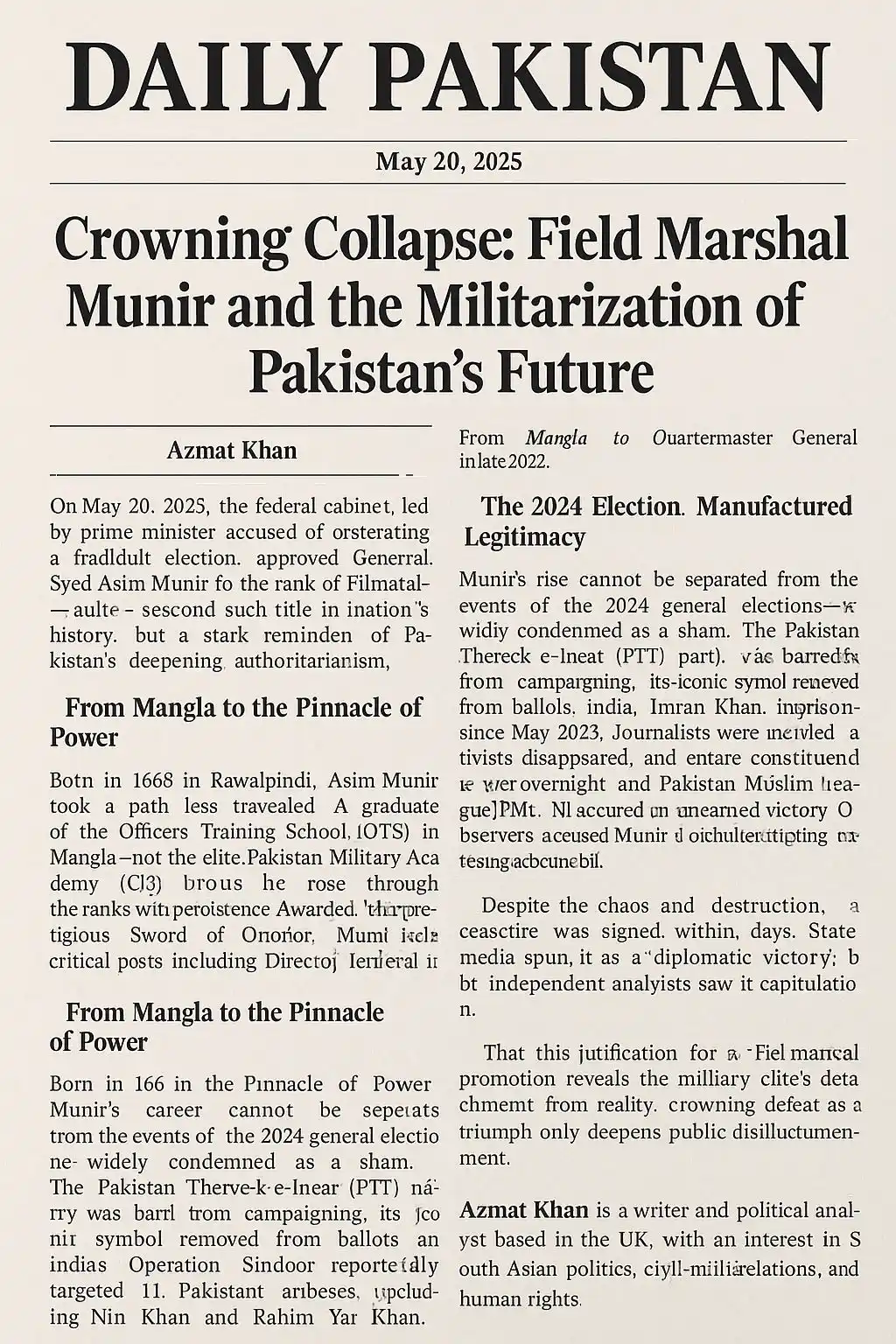
📰 Crowning Collapse: Field Marshal Munir and the Militarization of Pakistan’s Future
By Azmat Khan
May 20, 2025
⸻
On May 20, 2025, the federal cabinet of Pakistan, led by a prime minister accused of orchestrating a fraudulent election, approved the promotion of General Syed Asim Munir to the rank of Field Marshal—the second such title in the nation’s history. Celebrated by state media as a reward for “exceptional leadership” in recent military operations against India, this five-star promotion is not a symbol of victory, but a stark reminder of Pakistan’s deepening authoritarianism.
The move comes as the country teeters on the edge: inflation exceeds 30%, civil liberties have been crushed under the boot of military tribunals, and unrest in Balochistan and Khyber Pakhtunkhwa grows more desperate by the day. While cities burn and citizens protest, Munir crowns himself with a ceremonial rank, shielding failure behind grandiosity.
⸻
From Mangla to the Pinnacle of Power
Born in 1968 in Rawalpindi, Asim Munir took a path less traveled. A graduate of the Officers Training School (OTS) in Mangla—not the elite Pakistan Military Academy in Kakul—he rose through the ranks with persistence. Awarded the prestigious Sword of Honour, Munir held critical posts including Director General of Military Intelligence (2017) and later, the Inter-Services Intelligence (ISI) (2018–2019). His ISI tenure, however, ended abruptly—reportedly after clashing with then-Prime Minister Imran Khan.
Facing retirement as Quartermaster General in late 2022, Munir’s career was seemingly over. But in a dramatic twist, the Ministry of Defence rejected his retirement request just days before it would take effect. On November 24, 2022, Prime Minister Shehbaz Sharif—reportedly under the influence of his brother, Nawaz Sharif—appointed Munir as Chief of Army Staff (COAS). The decision sparked widespread speculation that a compliant general was being installed to secure the ruling elite’s grip on power. In 2024, his term was quietly extended to five years.
⸻
The 2024 Election: Manufactured Legitimacy
Munir’s rise cannot be separated from the events of the 2024 general elections—widely condemned as a sham. The Pakistan Tehreek-e-Insaf (PTI) party was barred from campaigning, its iconic symbol removed from ballots, and its leader, Imran Khan, imprisoned since May 2023. Journalists were muzzled, activists disappeared, and entire constituencies were reshaped overnight. In this manipulated environment, the Pakistan Muslim League (PML-N) secured an unearned victory. Observers accused Munir of playing kingmaker, orchestrating the vote to install a pliable government.
With military courts now approved by the Supreme Court to try civilians, dissent is criminalized. Political opponents vanish under vague anti-terror laws. This is not stability—it is submission.
⸻
A Hollow Promotion, a Tarnished Legacy
The government claims Munir’s elevation to Field Marshal is in recognition of his leadership during Operations Bunyan-um-Marsoos and Marka-i-Haq, launched after the April 22, 2025 terror attack in Pahalgam, India, that killed 26 civilians. In retaliation, India’s Operation Sindoor reportedly targeted 11 Pakistani airbases, including Nur Khan and Rahim Yar Khan. Munir’s command response was slow and confused, with reports of him coordinating from a secure bunker in Rawalpindi as Indian airstrikes exposed Pakistan’s vulnerabilities.
Despite the chaos and destruction, Pakistan signed a ceasefire within days. State media spun it as a “diplomatic victory,” but independent analysts saw it as capitulation. That this is being used to justify a Field Marshal promotion reveals how detached the military elite is from reality. Crowning defeat as triumph only deepens the public’s disillusionment.
Balochistan: The Nation’s Open Wound
While Asim Munir celebrates his elevation, Balochistan burns. The resource-rich yet impoverished province is gripped by insurgency, fueled by decades of economic neglect, political exclusion, and military repression. On March 11, 2025, militants from the Baloch Liberation Army (BLA) hijacked the Jaffar Express, killing non-Baloch passengers and paramilitary personnel. Protests in Gwadar, Quetta, and Dera Bugti demand autonomy and an end to what locals call “state looting.”
Former Chief Minister Sardar Akhtar Mengal has warned that the unrest may surpass the 1971 Bangladesh crisis. Munir’s response has been to authorize a “brutal crackdown” on 1,500 alleged insurgents—ignoring the deeper grievances that fuel the conflict.
Simultaneously, the region is a hub of oil smuggling. Cheap fuel flows in from Iran, enriching smugglers allegedly protected by military and political elites. A 2024 economic report estimated losses of $1.5 billion annually, a figure that represents not just economic mismanagement, but complicity.
⸻
Enforced Disappearances: The Forgotten Thousands
Perhaps the most damning stain on Munir’s tenure is the continued crisis of enforced disappearances. Human rights organizations estimate that over 5,000 people have gone missing since 2001—activists, students, journalists, and ordinary citizens, many of them Baloch or Pashtun. Families camp outside government buildings, holding faded photographs of loved ones. Yet the state labels them “terrorist sympathizers,” refusing accountability.
⸻
The Real Cost of War and Silence
The recent India-Pakistan clash left hundreds dead, though Pakistan has released no official figures. In Khyber Pakhtunkhwa, drone strikes—many reportedly U.S.-approved—have killed over 200 civilians in the last year alone. Women and children make up a disproportionate number of casualties. Inflation spirals, unemployment soars, and more than 5,000 officers have reportedly resigned or sought early retirement since April 2025.
Yet amidst all this, Munir dons a ceremonial rank few believe he earned. The contradiction is jarring: a general honored for a war that destabilized the region and for presiding over a military that continues to erode the nation’s social and democratic fabric.
⸻
A Nation Betrayed
General Asim Munir’s promotion to Field Marshal is not a reward for excellence—it is a desperate attempt to cement his legacy and tighten the military’s grip on a fragile republic. It will not rebuild airbases. It will not silence the cries of the missing. It will not stop oil smuggling, inflation, or insurgency.
Pakistan’s real heroes are not in Rawalpindi headquarters, but in Gwadar’s streets, Quetta’s protest camps, and Peshawar’s schools. They are the mothers of the disappeared, the journalists who still dare to report, and the youth who refuse to be silenced.
Munir’s title is a hollow crown. It signifies not strength, but the military’s increasing isolation from the people it claims to protect. Until Pakistan dismantles this culture of impunity and restores civilian supremacy, no title—no matter how grand—can redeem the betrayal of its people.
⸻
Azmat Khan is a writer and political analyst based in the UK, with an interest in South Asian politics, civil-military relations, and human rights.
👍
1